The banner is to inform visitors of an important message

.webp)
What you’ll learn: Why amateurs consistently come up short on par 3s, The difference between carry distance and total distance, How to account for imperfect strikes, Why better players often club up, How smart target selection lowers scores immediately
0:00
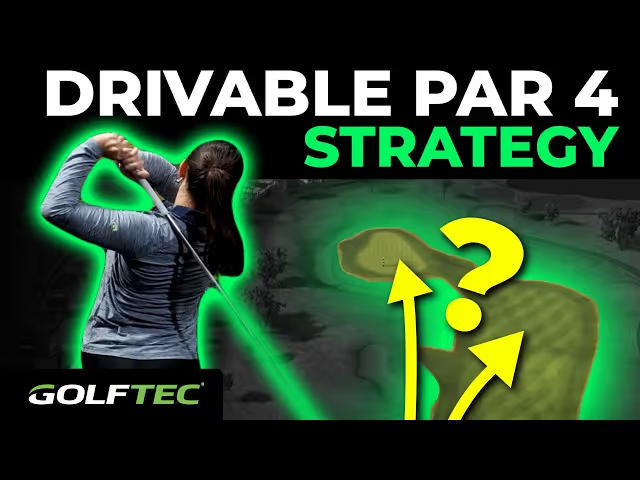
Coach: I’ve got Payton with me today. We’re going to talk some strategy for high handicappers. We’ll probably do a couple different versions of this, but we’ll start with a par three. I’ve got one pulled up here—we’ll talk through how Payton would play it and whether that’s a good or bad approach.
0:19
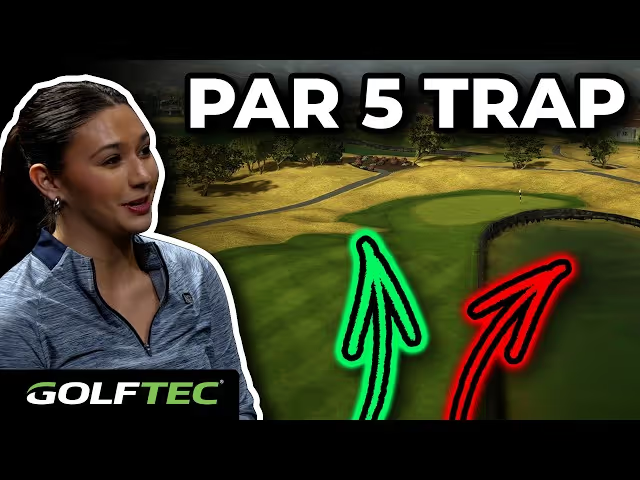
Coach: Alright, no pressure—this should be easy. We’re at PGA West. This is one of their signature holes. There’s water—it’s basically an island green.
Let’s do a quick flyover so you can see it. This is a pretty typical hole location, with the pin in the front right of the green. You’ve got 100 yards from the tee box.
What would you do here if this were real golf? What club are you hitting? Where are you aiming?
0:38
Payton: From 100 yards, I’d probably hit a pitching wedge. I can hit that a little farther than 100, so I’m not right on the edge risking it going in the water. I’d try to land it past the pin and let it roll a bit.
0:59
Coach: Okay, cool—that’s actually a really good point.
I see a lot of amateur golfers go through this same process: they pull up in their cart, grab their rangefinder, shoot the flag, it says 99 yards, and they go, “Alright, I’ll hit my 99-yard club.”
Then they don’t hit it perfectly, it comes up short, ends up in the water, and now they’re making double or triple. It gets bad quickly.
1:23
Coach: So I like what you said—picking a club that goes a little past the number.
The way I’d think about this is your minimum carry distance. In this case, it’s about 100 yards. Whatever club you choose has to carry at least 100 yards in the air.
A lot of high handicappers say, “I hit my pitching wedge 110 yards,” but maybe only 100 of that is carry and the rest is roll. You have to account for that—especially with water short.
1:53
Coach: So I like the pitching wedge choice. The only other thing I’d add is adjusting your target depending on the pin location.
This one is pretty much middle-right, so you could shift your aim slightly depending on the shot you want to hit.
For you, we’ll just go right at the flag—but with the mindset of hitting it about 110, not 99.
1:59
You’ve got this. No pressure.
2:19
We’ve only got one golf ball, so don’t hit it in the water.
2:27
Coach: Sounded pretty good.
2:28
Pretty good—there we go.
2:32
Coach: Nice—that was a great shot. Really, really good.
You carried that about 96 yards. I know you didn’t hit it perfectly in the center of the face, but that’s exactly why we plan to hit it a little past the hole.
2:43
Coach: The best players in the world do this every time—whether you realize it or not, this is how they think.
So for high handicappers, you don’t need to get super technical, but planning ahead and choosing a club that gives you the best chance to reach the green is the first step.
3:01
Coach: Nice shot. Good job.
3:02
Payton: Thanks.
Ready to elevate your game? Book a lesson or fitting at your nearest GOLFTEC location today!


Enter your info to have one of our expert coaches reach out about lessons, club fittings or practice!

.avif)
.avif)
.avif)
.avif)
.avif)