

As golfers age, a natural decrease in flexibility and muscle speed often leads to a noticeable loss in driving distance. Many senior golfers attempt to compensate for this loss of mobility by forcing speed with their arms, introducing critical swing faults that further destroy distance and accuracy. Drawing from GOLFTEC’s database of millions of swings, this guide identifies the top 3 swing faults caused by aging and offers data-driven mechanics fixes to restore lost yards without risking injury.
Table of Contents:
Josh Troyer makes his living asking players what is wrong with their game. As GOLFTEC's Director of Teaching Quality and a PGA Professional, he spends his days looking at what separates the students who improve from the ones who stall, and distance comes up first more often than anything else.
"One of the things that I hear a ton from people who shoot higher scores is that they don't hit the ball as far as they would like to," Troyer says.
A shorter drive means a longer club into every par 4, and a longer club means a bigger miss. But the usual responses—buying a new driver, swinging harder, chasing the newest tip on social media—tend to address the symptom and leave the cause alone.
Troyer's answer comes in two parts, and neither requires new equipment. The first trains the body to move faster. The second gives it more room to do it.
Why Swinging Something Lighter Makes You Faster
Overspeed training has been around long enough that most serious golfers have seen it, usually as a set of weighted sticks swung in a living room. The idea is simple. Swinging something lighter than a driver lets the body move faster than it normally would, and the nervous system gradually accepts that faster pattern as normal. The heavier sticks in most sets build the strength side of the equation.
"This trains your body to move faster, especially when you're using the lighter weight ones," Troyer says. "And this is how you can build clubhead speed very quickly."
The research supports the short-term effect, with some caveats. A 2021 study from the University of Brighton, published in the Journal of Sport and Exercise Science, tested 13 skilled collegiate golfers (average handicap around 1) on three warm-up routines. Both an overspeed warm-up with speed sticks and a bodyweight warm-up produced more clubhead speed than a standard warm-up, and the overspeed version also produced more carry distance. The overspeed sticks didn't beat the bodyweight routine on speed, though, and ball speed and total distance didn't change.
Much of the evidence for long-term gains comes from the companies that sell the systems, in the form of case studies on individual players rather than controlled trials. That doesn't mean the approach doesn't work. It means the realistic expectation should be steady, incremental gains from consistent sessions, not a 15-yard jump by Saturday.
The Overspeed Gear You Already Have
The specialized sets work, and Troyer is happy to see students use them. But golfers who don't own one already have a serviceable version in the bag.
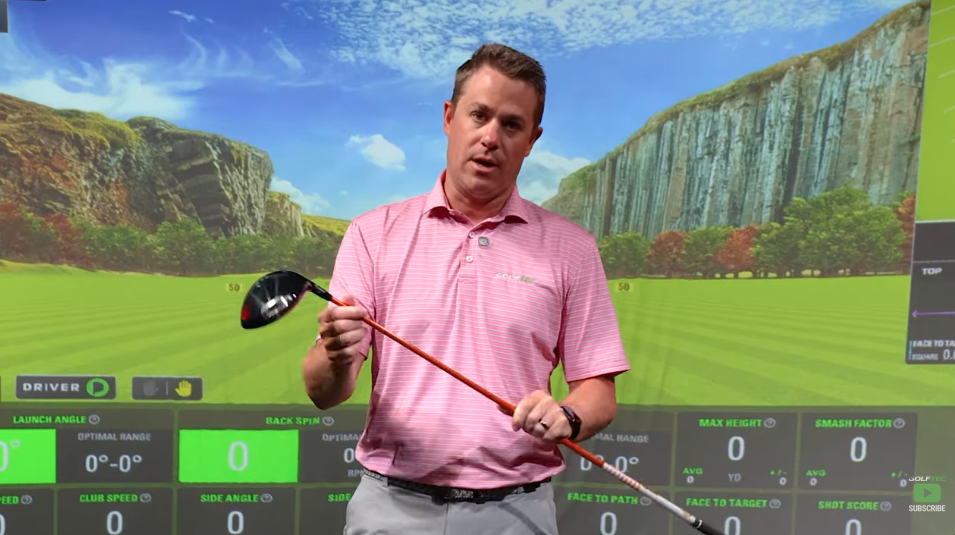
"You can take your current driver, if it's adjustable, just pop the head off. Then you've got a really lightweight shaft, 60, 65 grams, something like that," he says. "That's a lighter version of a driver that's going to train your body to move faster."
A standard driver head weighs roughly 200 grams, so removing it strips out most of the club's swinging weight. A driver without an adjustable hosel works almost as well flipped upside down and held just below the head, which takes the weight out of the far end of the club. Either way, the goal is the same—make a series of full-speed swings with something that moves faster than a driver can, then go back to the real thing.
The drill takes a few minutes, costs nothing and fits into a warm-up before a range session or a round. It's also the half of Troyer's advice that most golfers will find easy to accept.
The X-Factor Advice That Shrinks Your Backswing
Now, it's time to unlearn something you might have thought has been helping you for years.
For three decades, a version of the X-factor—the separation between how far the shoulders turn and how far the hips turn in the backswing, popularized by Jim McLean in the 1990s—has filtered down to the range as a simple instruction to keep the hips quiet and wind the shoulders against them. The logic sounds right. A bigger gap between the two should store more energy.
Troyer hears it from students all the time. "People even now tell me, 'I'm trying to not turn my hips and turn my shoulders as much as I can to create this gap,'" he says. "That's fine, but the problem with that is it limits the amount of mobility that you have. So I would actually encourage you to do the opposite. Turn your hips as much as you can."
The problem is physical. Tour players with exceptional flexibility can hold their hips relatively still and still get their shoulders turned 90 degrees or more. A 50-year-old with a desk job and tight hamstrings can't. When he restricts his hips, his shoulders stop short too, and the club ends up well short of where it could be at the top. He's built a gap and lost a backswing.
The longest hitters in the game point the other way. Watch a competitive long-drive player and the lead heel often comes off the ground in the backswing, the hips turning freely so the shoulders can turn even farther.
"The more you can turn and rotate in the backswing, the further the club can move behind you," Troyer says, "thus the further distance it has to travel back to the golf ball, which helps you create more speed."
That's the whole mechanism. More turn means a longer runway.
How Much Hip Turn Is Enough?
"The best golfers in the world on average are right around 45 degrees closed at the top of the swing," he says. Closed, in this case, means the hips have rotated 45 degrees away from the target compared with where they started at address. "If you can get to 45 or 50, that's totally fine, especially when you're looking for distance."
GOLFTEC's motion-capture data shows the same separation between good and struggling players at the other end of the swing. In a SwingTRU study of 30,000 golfers published in Golf Digest, tour players averaged 36 degrees of hip turn toward the target at impact, compared with 19.5 degrees for golfers who shoot over 100—almost twice as much rotation through the ball. Hips that never got going back rarely have room to clear on the way through.
None of this is a feel a golfer can confirm in a mirror. Most players who believe they're making a full turn are well short of 45 degrees, and the ones who have been told to restrict their hips are often shorter still. That gap between what a swing feels like and what it measures is where most distance hides, and it's the reason a number matters more than a feeling here.
Troyer's prescription, taken together, is modest. Swing something lighter than a driver to teach the body a faster pattern, then let the hips turn freely enough that the shoulders can follow. The longest hitters in the world are already doing both. "Turn your hips as much as you can," he says. "That'll allow you to turn your shoulders as much as you can. Then you can bomb drives like this."
A GOLFTEC Game Evaluation measures your hip and shoulder turn at the top against tour averages, so you know how much distance your backswing is leaving on the table.

Play the best golf of your life. GOLFTEC Coaches use cutting-edge tech and proven methods to level up your game fast.
Book a Lesson
Play Better!
Book a Fitting
Play Better!