.webp)

Table of Contents:
Every April, millions of golfers watch the Masters and come away with the same thought: I want to do that.
Not the green jacket part most of us made peace with that reality a long time ago. The other part. The part where Scottie Scheffler hits a towering 5-iron over Rae’s Creek and lands it with the precision of a flip wedge. Or where Rory McIlroy shapes a draw off the right tree line on 13 challenges the creek-protected landing area. You watch these shots and something fires in your prehistoric brain a combination of inspiration and determination that usually ends with you booking a tee time and spraying drives into the woods by Saturday morning.
But there’s a smarter play. Instead of rushing to the course to imitate what you saw, take what you saw into your next golf lesson. The Masters telecast—especially the modern version, with its real-time ball-flight data, swing analysis, and course-strategy graphics—is handing you a cheat sheet of topics to discuss with your instructor. You just have to know what to ask. (Learn more how we've helped BEGINNER, WOMEN, seasoned golfers improve their game)
1. “My ball doesn’t do what theirs does in the air. What’s the difference in my delivery?”
This is the big one, and the beauty of modern lesson technology is that your coach can show you exactly why—not guess.
When you watch a tour player hit a 7-iron that climbs high, hangs in the air, and drops softly onto the green, what you’re seeing is a specific combination of club-head speed, angle of attack, and dynamic loft at impact. Those three things produce the launch angle and spin rate that make a ball behave that way. Your 7-iron probably flies lower, runs hotter, and doesn’t hold greens and the reason lives in your delivery, not in some mysterious talent gap.
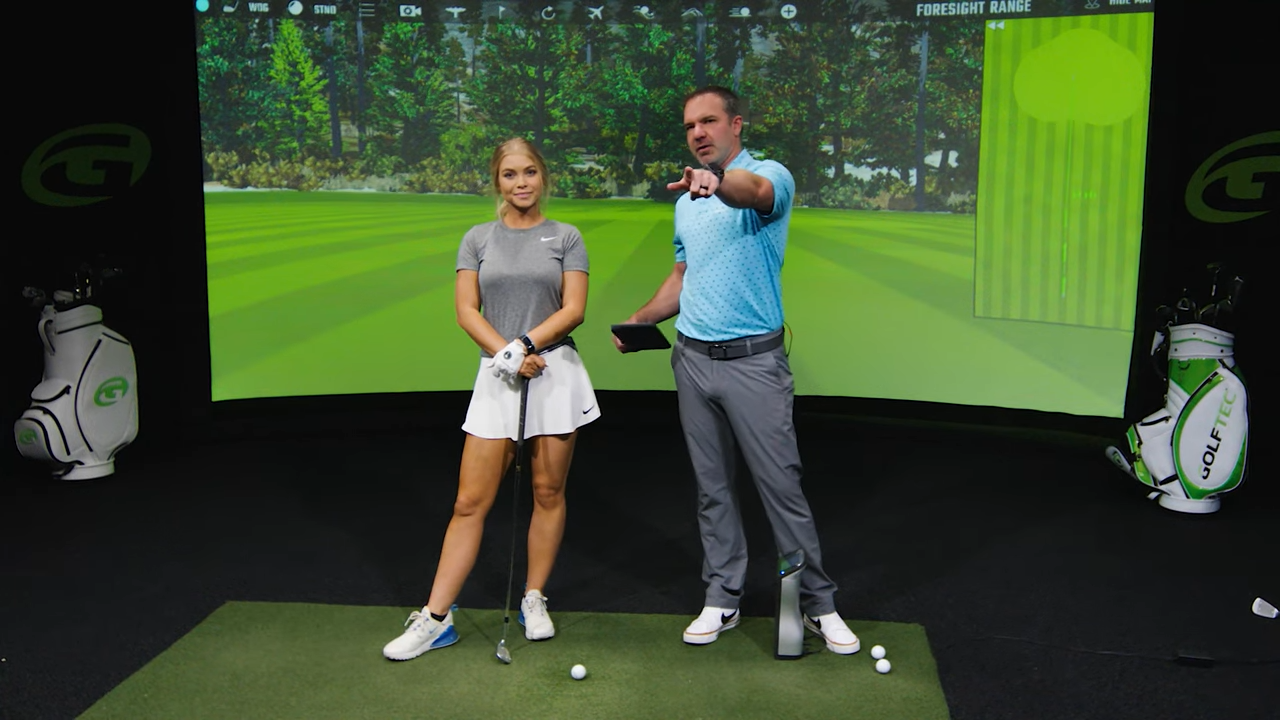
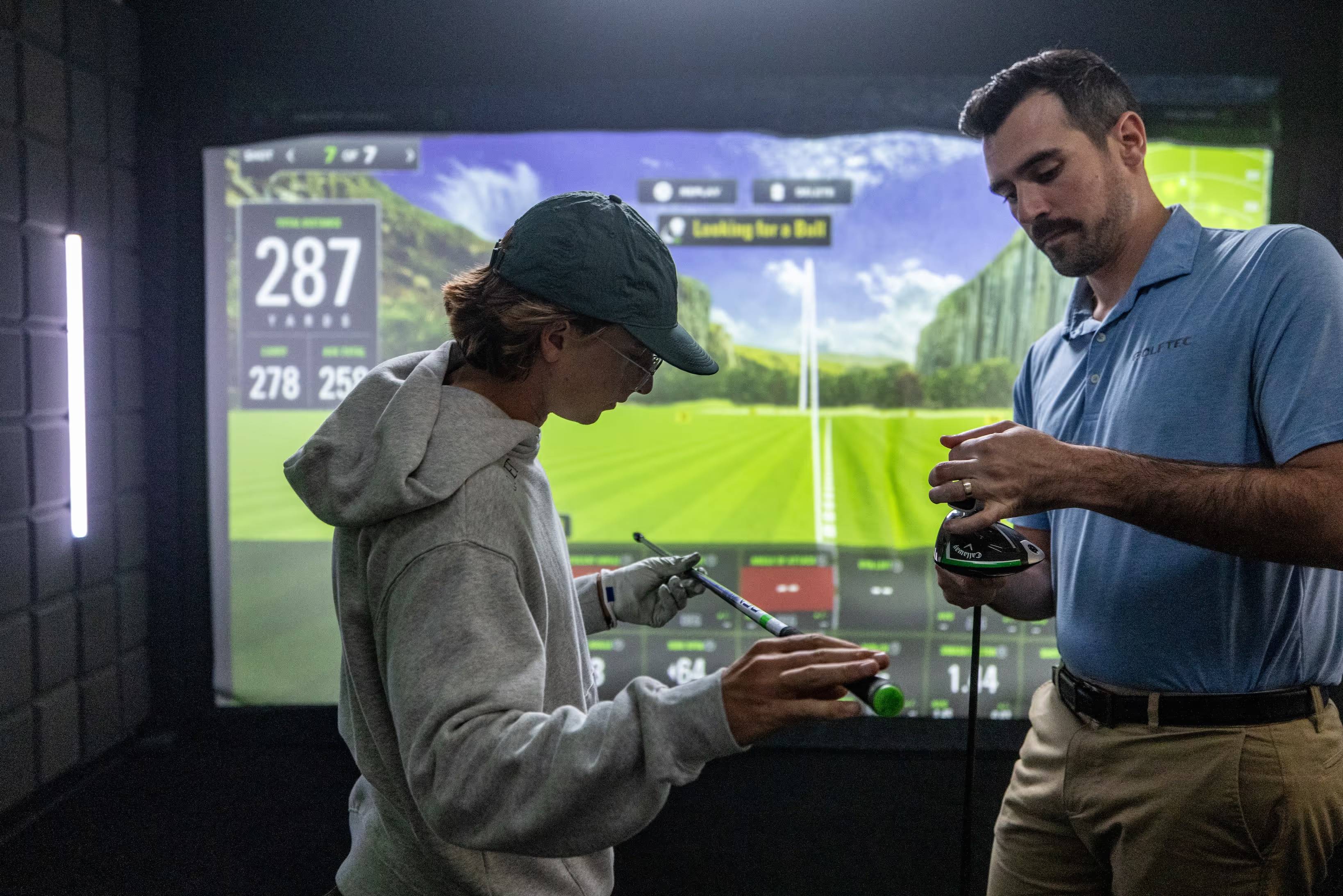
A technology-infused lesson like those at GOLFTEC captures your body position at every point in the swing and pairs it with launch monitor data. Your coach can pull up your angle of attack, compare it to a tour benchmark, and show you on the spot which body movements are steepening or shallowing the club through impact. It’s the kind of diagnosis that used to take a world-class eye. Now the data does half the work.
The key is to bring the specific observation. Don’t say “I want to hit it like Scheffler.” Say, “My irons don’t get in the air. What’s happening at impact that produces a low, running shot instead of one that holds the green?”
2. “How do they shape the ball both ways? Can I learn that?”
Augusta demands shot shaping. The 13th hole wants a draw. The 18th hole wants a fade. Elite players often switch between them so casually that it can look like sorcery if you’ve been fighting the same slice for 15 years.
It’s not sorcery. It’s the relationship between club path and face angle, and it’s measurable in your very next lesson. The face direction at impact determines roughly 75 to 80 percent of where the ball starts. The path creates the curve. If your coach can show you your numbers say, a path that’s 5 degrees left with a face that’s 2 degrees left you can see why you hit a pull-fade. Then it’s a matter of adjusting one variable at a time.
The honest answer to “Can I learn that?” is usually yes, within limits. You might not develop a 20-yard draw and a 20-yard fade on demand. But moving from one-shape-only to having a reliable stock shot and a playable alternative is absolutely realistic and it’s one of the most valuable things a lesson series can deliver.
3. “I noticed players almost never short-side themselves. How do I pick smarter targets?”
This is the question your coach secretly hopes you’ll ask, because it means you’ve started thinking about golf as a strategic game and not just a ball-striking contest.
Watch where the misses land at Augusta. When a player misses the green at the par-3 12th, they almost always miss long and right—the safe side—even though the pin might be tucked left over the water. When they miss at the 11th, it’s usually right of the green, leaving an uphill chip, not a downhill nightmare toward the pond.
Your coach can help you build this kind of thinking into your game at your home course. It starts with a simple question for every approach shot: Where is the trouble, and where is the bail-out? GOLFTEC coaches often use video review of on-course footage some students bring their own to identify patterns in where you miss and whether your misses are falling on the expensive side.
You don’t need Augusta-level course knowledge. You need the discipline to aim at the fat part of the green when the flag is near trouble. That single habit might save you more strokes than any swing change.
4. “Those guys get so much spin on their wedges. Is that something I can work on, or is it all clubhead speed?”
This one comes up every Masters when the cameras catch a wedge shot that rips backward on a glass-slick green. The short answer: It’s not all speed, and yes, you can improve it.
Backspin on wedge shots comes primarily from clean contact—ball first, then turf—combined with sufficient loft and speed. Tour players aren’t scooping or chopping. They’re delivering the club with the face square, the grooves making clean contact with the ball, and enough speed to generate friction. The divot comes after the ball, not before it.
Your instructor can use your launch data to see exactly how much spin you’re producing versus how much you should be producing given your speed. If you’re leaving spin on the table, the culprit is usually strike quality hitting it slightly fat, slightly thin, or with debris between the face and ball. That’s a solvable problem with some focused short-game work, and it pays off immediately around the greens.
5. “How do they stay so calm under pressure? Is there a mental routine I should be using?”
The Masters telecast loves to show players in their pre-shot routines—the deep breath behind the ball, the waggle, the committed walk into the shot. What you’re seeing isn’t just habit. It’s a deliberate system for managing adrenaline and narrowing focus.
Your coach may or may not be a sports psychologist, but most experienced instructors have seen the damage that on-course anxiety does to a swing and have practical tools to address it. A consistent pre-shot routine something that takes the same amount of time and involves the same steps on every shot—is the simplest and most effective mental tool available to any golfer. It gives your brain a checklist to follow instead of a void to fill with doubt.
Ask your coach to help you build one. It doesn’t need to be elaborate. Scheffler’s isn’t. A breath, a look at the target, a single swing thought—that’s enough structure to quiet the noise.
6. “Based on what we’re working on, what should I be watching for during the broadcast?”
This is the question that turns passive viewing into active learningand it gives your coach the chance to customize your Masters experience based on your specific game.
If you’re working on improving your backswing turn, your coach might tell you to watch how Rahm loads into his right side. If you’re working on speed, maybe it’s studying how DeChambeau uses the ground. If you’re focused on short game, pay attention to how players handle the challenging chips and pitches around Augusta’s crowned greens—where the ball can run away from you in a heartbeat if the technique isn’t precise.
The best version of this conversation happens before the tournament starts. Book a lesson early in the week, tell your coach you want to watch the Masters with better eyes, and let them give you a specific assignment. Then come back the following week and talk about what you saw. That two-lesson bookend—one before, one after—turns four days of television into a structured learning experience that sticks.
The moral of the story? Don't just watch The Masters. Learn from it.

Play the best golf of your life. GOLFTEC Coaches use cutting-edge tech and proven methods to level up your game fast.
Book a Lesson
Play Better!
Book a Fitting
Play Better!